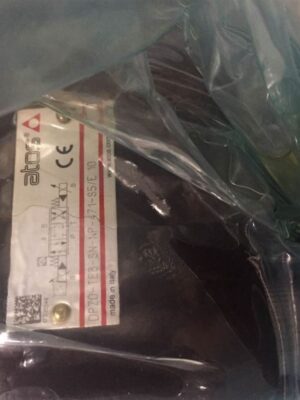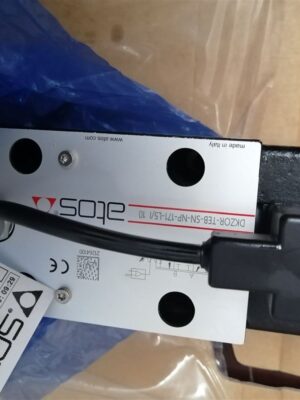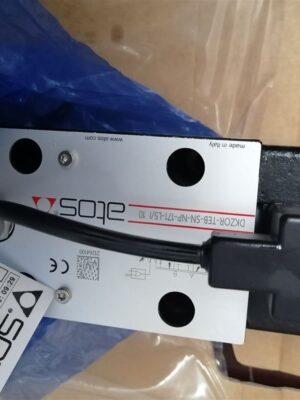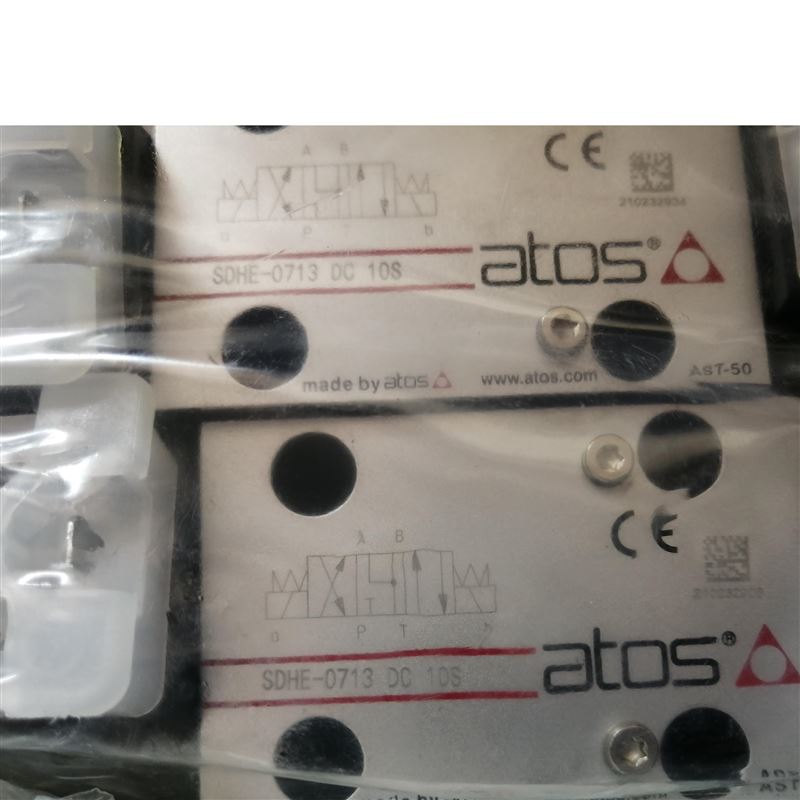
ATOSAGAM-20/11/350/M-AO/V
ATOSAGAM-20/11/350/M-AO/V
Brand
ATOS
ATOS proportional valves control flow in two ways: One is on/off control: either fully open or fully closed, with flow either at its maximum or minimum, without intermediate states, such as ordinary solenoid direct-flow valves, solenoid directional valves, and electro-hydraulic directional valves. The other is continuous control: the valve port can open to any degree as needed, thereby controlling the flow rate. These valves can be manually controlled, such as throttle valves, or electrically controlled, such as proportional valves and servo valves. Therefore, the purpose of using proportional or servo valves is to achieve throttling control of flow rate electronically (of course, pressure control can also be achieved through structural modifications). Since it is throttling control, there is inevitably energy loss. Servo valves differ from other valves in that their energy loss is greater because they require a certain flow rate to maintain the operation of the pre-stage control circuit.
Differences between ATOS proportional valves and servo valves:
Mainly reflected in the following points:
1. Different drive devices. 1. **Differences in Driving Mechanisms:** Proportional valves are driven by proportional electromagnets; servo valves are driven by force motors or torque motors.
2. **Differences in Performance Parameters:** Hysteresis, dead zone, bandwidth, and filtration accuracy differ, leading to different applications. Servo valves and servo-proportional valves are primarily used in closed-loop control systems, while other types of proportional valves are mainly used in open-loop control systems and closed-loop speed control systems.
2.1 Servo valves have no dead zone at mid-position, while proportional valves do.
2.2 Servo valves have a higher frequency response, reaching up to approximately 200Hz, while proportional valves typically have a maximum frequency of tens of Hz.
2.3 Servo valves have higher requirements for hydraulic fluid, requiring fine filtration to prevent clogging, while proportional valves have lower requirements.
3. **Differences in Valve Core Structure and Machining Precision:** Proportional valves use a valve core + valve body structure, with the valve body also serving as the valve sleeve. Servo valves and servo-proportional valves use a valve core + valve sleeve structure.
4. **Differences in Mid-Position Functions:** Proportional directional valves have a neutral position function similar to ordinary directional valves, while servo valves only have an O-type neutral position function (E-type for Rexroth products).
5. The rated pressure drop of the valves differs.
ATOS proportional servo valves have performance between servo valves and proportional valves.
ATOS proportional directional valves are a type of proportional valve used to control flow rate and direction.
Extended Information—Automatic control of electro-proportional valves can be divided into intermittent control and continuous control. Intermittent control is on-off control. Pneumatic control systems use on-off (ON-OFF) directional valves with low operating frequencies to control the opening and closing of the air path. Pressure reducing valves regulate the required pressure, and throttle valves regulate the required flow rate. This traditional pneumatic control system requires multiple pressure reducing valves, throttle valves, and directional valves to achieve multiple output forces and multiple movement speeds. This not only requires more components, increases cost, and complicates the system, but also requires many components to be manually adjusted in advance. Electro-proportional valve control is a type of continuous control, characterized by the output changing with the input, and a certain proportional relationship exists between the output and input. Proportional control can be divided into open-loop control and closed-loop control.
ATOS Proportional Valve Structure and Principle
When the input signal to the ATOS proportional valve increases, the pilot valve 1 of the supply solenoid valve switches, while the exhaust solenoid pilot valve 7 is in the reset state. The supply pressure then enters the pilot chamber 5 from the SUP port through valve 1. The pilot chamber pressure rises, and the air pressure acts on the diaphragm 2, causing the supply valve core 4 connected to diaphragm 2 to open, and the exhaust valve core 3 to close, generating output pressure. This output pressure is fed back to the control loop 8 through the pressure sensor 6. Here, a rapid comparison and correction is performed with the target value until the output pressure is proportional to the input signal, thus achieving a proportional change in output pressure to the input signal. Because there is no nozzle-baffle mechanism, the valve is insensitive to impurities and has high reliability.
ATOS Proportional Valve Features
1) It can achieve stepless adjustment of pressure and speed, avoiding the impact phenomenon during switching of normally open on/off valves.
2) It can achieve remote control and program control.
3) Compared with intermittent control, the system is simplified, and the number of components is greatly reduced. 4) Compared to hydraulic proportional valves, it is smaller, lighter, simpler in structure, and lower in cost, but its response speed is much slower than that of a hydraulic system, and it is more sensitive to load changes.
5) It uses less power, generates less heat, and produces less noise.
6) It will not cause a fire and will not pollute the environment. It is less affected by temperature changes. ATOS Proportional Valve Stock List:
DHZO-AE-073-S5 10
DHZO-AE-073-S5/I 10
DHZO-AT-073-P3 20
DHZO-ATE-073-P3/B/DP27SB 20
DHZO-T-051-L1
DHZO-T-051-L5 31
DHZO-T-071-D5
DHZO-T-071-L5
DHZO-T-071-S5
DHZO-TE-051-L5/Y 40
DHZO-TE-071-L5
DHZO-TE-071-S5 40 /PE
DHZO-TE-073-S5
DKZA-A-173-L5/PA-M/7 DKZO-A-151-S5
DKZO-A-171-L5
DKZO-A-173-S5
DKZOR-A-151-S5
DKZOR-A-151-S5/18 40
DKZOR-A-151-S5/B
DKZOR-A-153-L5/B
DKZOR-A-171-D5 40
DKZOR-A-171-L5
DKZOR-A-171-S5
DKZOR-A-171-S5/18
DKZOR-A-173-D5
DKZOR-A-173-L5
DKZOR-A-173-L5/18 40
DKZOR-A-173-L5/Y DKZOR-A-173-S3
DKZOR-A-173-S5
DKZOR-A-173-S5/18
DKZOR-AE-171-L5 10
DKZOR-AE-171-S5
DKZOR-AE-171-S5 10/WG
DKZOR-AE-171-S5/Y 10
DKZOR-AE-173-D5 10
DKZOR-AE-173-L5 10
DKZORC-A-151-S5/18 The company mainly deals with European and American brands and can source brands from any European country. For example, our key German brands include: BURKERT, DEMAG, HAWE, REXROTH, HYDAC, PILZ relays, FESTO, IFM sensors, E+H, HEIDENHAIN, P+F sensors, SICK, TURCK, and HIRSCHMANN industrial switches. German brands: Hengstler, Murr, Schmersal, Samson, EPRO (Emerson Group)
American brands: MOOG, ASCO, MAC, NUMATICS, PARKER, VICKERS, ROSS
British brands: Norgren
Italian brands: OMAL, ATOS, CAMOZZI, UNIVER, Camozzi