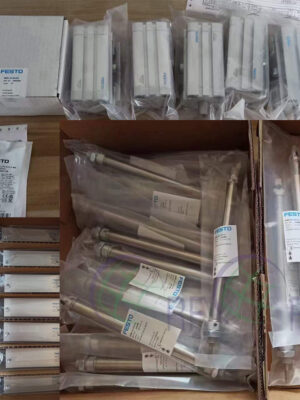
German FESTO cylinder DSNU-8-10-P-A available in Shanghai.
German FESTO cylinder DSNU-8-10-P-A available in Shanghai.
German FESTO cylinders come in many varieties, generally classified according to their structural features, function, drive method, or installation method. The classification methods also vary. Based on structural features, cylinders are mainly divided into piston cylinders and diaphragm cylinders. Based on motion, they are divided into linear motion cylinders and rotary cylinders.
Brand
FESTO
Action Method
Other
Application Areas
Medical & Health, Environmental Protection, Biotechnology, Petroleum, Packaging/Paper/Printing
Structural Principles of Commonly Used FESTO Cylinders
1. FESTO Standard Cylinders
Includes single-acting and double-acting cylinders. Commonly used in applications without special requirements.
Figure 13-2 shows the basic structure of a commonly used single-rod double-acting standard cylinder. The cylinder generally consists of a cylinder barrel, front and rear cylinder heads, piston, piston rod, seals, and fasteners.
The cylinder barrel 7 is fixedly connected to the front and rear cylinder heads. The cylinder head 5 on the piston rod side is the front cylinder head, and the cylinder head 14 on the bottom side is the rear cylinder head. Intake and exhaust ports are provided on the cylinder heads, and some also have a gas buffer mechanism. The front cylinder head has a sealing ring, a dust ring 3, and a guide sleeve 4 to improve the cylinder’s guiding accuracy. The piston rod 6 is fastened to the piston 9. In addition to sealing rings 10 and 11 to prevent air leakage between the left and right chambers of the piston, the piston also has a wear-resistant ring 12 to improve the cylinder’s guiding performance; for cylinders with magnetic switches, a magnetic ring is installed on the piston. Rubber pads 8 are often installed on both sides of the piston as buffer pads. If it is a pneumatic buffer, buffer plungers are provided on both sides of the piston along the axial direction, and the cylinder head has a buffer throttle valve and a buffer sleeve. When the cylinder moves to the end, the buffer plunger enters the buffer sleeve. The cylinder exhaust must pass through the buffer throttle valve, increasing the exhaust resistance and generating exhaust back pressure, forming a buffer air cushion, which plays a buffering role. 2. FESTO Special Cylinders
1 – Cylinder Body
2 – Diaphragm
3 – Diaphragm Disc
4 – Piston Rod
To meet different working needs, various special cylinders have been designed and developed based on ordinary cylinders by changing or adding parts of the cylinder structure.
(1) FESTO Diaphragm Cylinder Figure 13-3 shows the working principle diagram of a diaphragm cylinder. Diaphragms come in two types: flat diaphragms and disc diaphragms. They are generally made of fabric-reinforced rubber, steel sheets, or phosphor bronze sheets, with a thickness of 5-6 mm (some use 1-2 mm thick diaphragms).
German FESTO cylinders come in many varieties, generally classified according to their structural characteristics, function, drive method, or installation method. The classification methods also differ. According to structural characteristics, cylinders are mainly divided into piston cylinders and diaphragm cylinders. According to the motion form, they are divided into linear motion cylinders and oscillating cylinders. 3. Installation Types of FESTO Cylinders
FESTO cylinders can be installed in the following ways:
1) Fixed FESTO Cylinders: The cylinder is fixed to the machine body and can be either foot-mounted or flange-mounted.
2) Pin-type FESTO Cylinders: The cylinder body can swing at a certain angle around a fixed axis. Types include U-hook and trunnion types.
3) Rotary FESTO Cylinders: The cylinder body is fixed to the machine tool spindle and can rotate at high speed with the spindle. This type of cylinder is often used in pneumatic chucks on machine tools to achieve automatic workpiece clamping.
4) Embedded FESTO Cylinders: The cylinder barrel is directly fabricated within the fixture body.
Double-acting cylinder. DNC-80-200-PPV-A Ordering code 163440
Double-acting cylinder. DNC-80-250-PPV-A Ordering code 163441
Double-acting cylinder. DNC-80-320-PPV-A Ordering code 163442
Double-acting cylinder. DNC-80-400-PPV-A Ordering code 163443
Double-acting cylinder. DNC-80-500-PPV-A Ordering code 163444
Double-acting cylinder. DNC-80-P Ordering code 163445
Double-acting cylinder. DNC-80–PPV Ordering code 163446
Double-acting cylinder. DNC-80-25-PPV Ordering code 163447
Double-acting cylinder. DNC-80-40-PPV Ordering code 163448
Double-acting cylinder. DNC-80-50-PPV Ordering code 163449
Double-acting cylinder. DNC-80-80-PPV Ordering code 163450
Double-acting cylinder. DNC-80-100-PPV Ordering code 163451
Double-acting cylinder. DNC-80-125-PPV Ordering code 163452
Double-acting cylinder. DNC-80-160-PPV Ordering code 163453
Double-acting cylinder. DNC-80-200-PPV Ordering code 163454
Double-acting cylinder. DNC-80-250-PPV Ordering code 163455
Double-acting cylinder. DNC-80-320-PPV Ordering code 163456
Double-acting cylinder. DNC-80-400-PPV Ordering code 163457
Double-acting cylinder. DNC-80-500-PPV Ordering code 163458
Our company mainly deals in European and American brands and can source brands from any European country. For example, our advantageous German brands include: BURKERT, DEMAG, HAWE, REXROTH, HYDAC, PILZ relays, FESTO, IFM sensors, E+H, HEIDENHAIN, P+F sensors, SICK, TURCK, and HIRSCHMANN industrial switches. German brands: Hengstler, Murr, Schmersal, Samson, EPRO (Emerson Group)
American brands: MOOG, ASCO, MAC, NUMATICS, PARKER, VICKERS, ROSS
British brands: Norgren
Italian brands: OMAL, ATOS, CAMOZZI, UNIVER, Camozzi