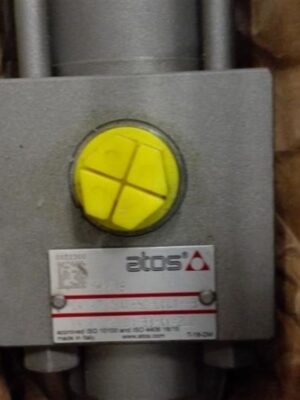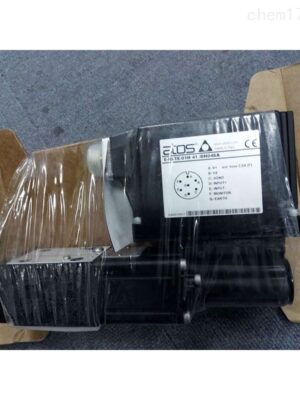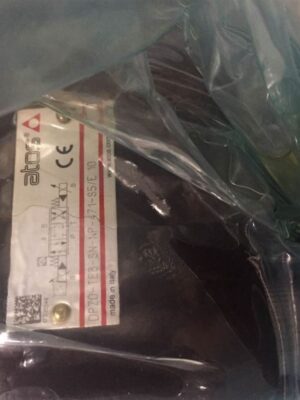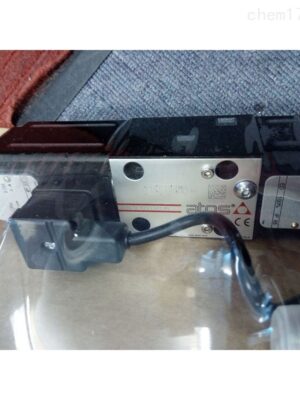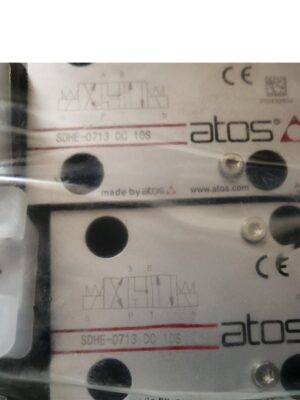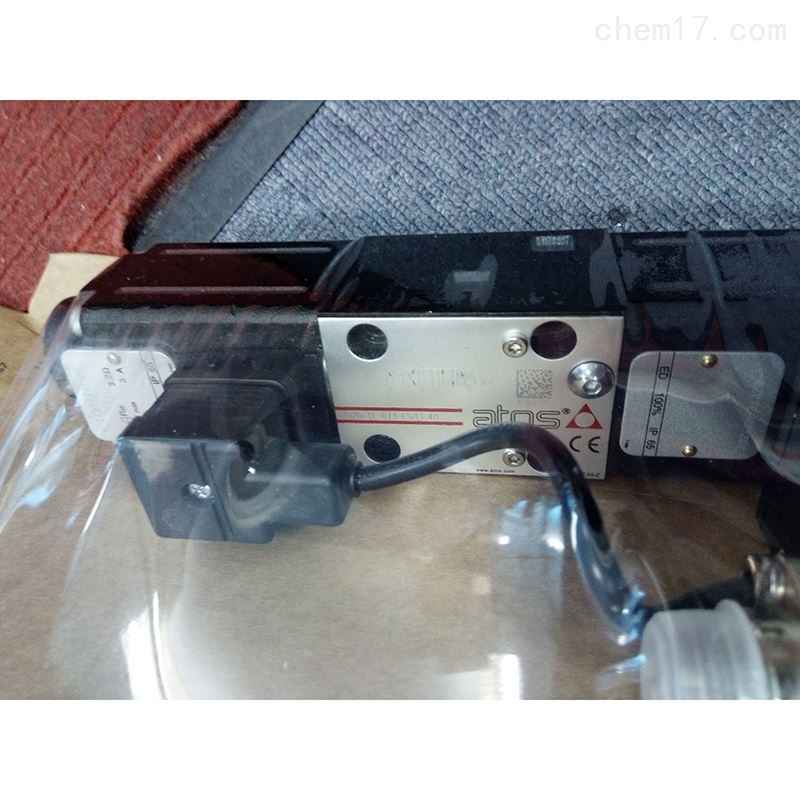
DKZOR-TEB-SN-NP-171-L5ATOS
DKZOR-TEB-SN-NP-171-L5ATOS
Brand
ATOS
Thank you for your interest in our products. If you would like to learn more, such as ATOS product prices, specifications, and other information, please feel free to contact us. We sincerely invite you to experience our satisfactory service!
ATOS Piston Pumps, ATOS Gear Pumps, ATOS Axial Piston Pumps, ATOS Vane Pumps, ATOS Hydraulic Cylinders, ATOS Relief Valves, ATOS Proportional Valves, ATOS Stack Valves
ATOS proportional valves can control flow in two ways: One is on/off control: either fully open or fully closed, with flow either at its maximum or minimum, without intermediate states. Examples include ordinary solenoid direct-flow valves, solenoid directional valves, and electro-hydraulic directional valves. The other is continuous control: the valve can open to any degree as needed, thereby controlling the flow rate. These valves can be manually controlled, such as throttle valves, or electrically controlled, such as proportional valves and servo valves. Therefore, the purpose of using proportional valves or servo valves is to achieve flow throttling control electronically (of course, pressure control can also be achieved through structural modifications). Since it is throttling control, there will inevitably be energy loss. Servo valves differ from other valves in that their energy loss is greater because they require a certain flow rate to maintain the operation of the pre-stage control circuit.
ATOS proportional valves have performance between servo valves and proportional valves.
Extended Information—Automatic control of electric proportional valves can be divided into intermittent control and continuous control. Intermittent control is on/off control. Pneumatic control systems use on/off directional valves with low operating frequencies to control the opening and closing of the air path. Pressure reducing valves regulate the required pressure, and throttle valves regulate the required flow rate. This traditional pneumatic control system requires multiple pressure reducing valves, throttle valves, and directional valves to achieve multiple output forces and multiple movement speeds. This not only requires more components, increases cost, and complicates the system, but also requires many components to be manually adjusted in advance. Electro-proportional valve control is a type of continuous control, characterized by an output that changes proportionally to the input. Proportional control can be open-loop or closed-loop.
ATOS Proportional Valve Structure and Principle:
When the input signal to the ATOS proportional valve increases, the pilot valve 1 of the supply solenoid valve switches, while the exhaust solenoid pilot valve 7 remains in the reset state. The supply pressure then enters the pilot chamber 5 from the SUP port through valve 1. The pressure in the pilot chamber rises, acting on the diaphragm 2. This opens the supply valve core 4 connected to diaphragm 2, while the exhaust valve core 3 closes, generating output pressure. This output pressure is fed back to the control loop 8 via pressure sensor 6. Here, a rapid comparison and correction is performed with the target value until the output pressure is proportional to the input signal, thus demonstrating that the output pressure changes proportionally to the input signal. Because there is no nozzle-baffle mechanism, the valve is insensitive to impurities and has high reliability.
ATOS proportional valve features:
1) Enables stepless adjustment of pressure and speed, avoiding the shock phenomenon during switching of normally open on/off pneumatic valves.
2) Enables remote and programmable control.
3) Simplifies the system and greatly reduces the number of components compared to intermittent control.
4) Compared to hydraulic proportional valves, it is smaller, lighter, simpler in structure, and lower in cost, but its response speed is much slower and it is more sensitive to load changes.
5) Low power consumption, low heat generation, and low noise.
6) Does not cause fires and does not pollute the environment. Less affected by temperature changes.
DHZO-A-073-S3 20
DHZO-A-073-S5
DHZO-AE-051-S5 10
DHZO-AE-071-D5/I
DHZO-AE-071-S5/I
DHZO-AE-073-D5/I/10
DHZO-AE-073-S5 10
DHZO-AE-073-S5/I 10
DHZO-AT-073-P3 20
DHZO-ATE-073-P3/B/DP27SB 20
DHZO-T-051-L1
DHZO-T-051-L5 31
DHZO-T-071-D5
DHZO-T-071-L5 DHZO-T-071-S5
DHZO-TE-051-L5/Y 40
DHZO-TE-071-L5
DHZO-TE-071-S5 40/PE
DHZO-TE-073-S5
DKZA-A-173-L5/PA-M/7
DKZO-A-151-S5
DKZO-A-171-L5
DKZO-A-173-S5
DKZOR-A-151-S5
DKZOR-A-151-S5/18 40
DKZOR-A-151-S5/B
DKZOR-A-153-L5/B
DKZOR-A-171-D5 40
DKZOR-A-171-L5 DKZOR-A-171-S5
DKZOR-A-171-S5/18
DKZOR-A-173-D5
DKZOR-A-173-L5
DKZOR-A-173-L5/18 40
DKZOR-A-173-L5/Y
DKZOR-A-173-S3
DKZOR-A-173-S5
DKZOR-A-173-S5/18 The company mainly deals with European and American brands and can source brands from any European country. For example, our key German brands include: BURKERT, DEMAG, HAWE, REXROTH, HYDAC, PILZ relays, FESTO, IFM sensors, E+H, HEIDENHAIN, P+F sensors, SICK, TURCK, and HIRSCHMANN industrial switches. German brands: Hengstler, Murr, Schmersal, Samson, EPRO (Emerson Group)
American brands: MOOG, ASCO, MAC, NUMATICS, PARKER, VICKERS, ROSS
British brands: Norgren
Italian brands: OMAL, ATOS, CAMOZZI, UNIVER, Camozzi